What Happens When an Ad Impression Goes Unsold?
In real-time bidding (RTB), an automated auction offers every ad impression to potential buyers. Although the process aims to connect each ad impression with the most relevant advertiser, some auctions still fail to result in a sale. Some ad impressions receive no bids, while others fail to meet the publisher’s pricing or quality requirements. These are known as unsold ad impressions, and they are a normal part of the programmatic advertising ecosystem.
When an ad impression goes unsold, the ad opportunity does not simply disappear. Depending on the publisher’s setup, the system may pass the ad impression to another demand source, offer it through a different auction, or fill it with alternative content such as a house ad. The exact outcome depends on the publisher’s monetization strategy and the available demand at that moment.
Understanding why impressions remain unsold is important for both publishers and advertisers. It helps publishers improve fill rate, optimize ad inventory, and increase revenue while giving advertisers insight into how inventory is valued, prioritized, and allocated across the programmatic marketplace.
Why Do Ad Impressions Go Unsold?
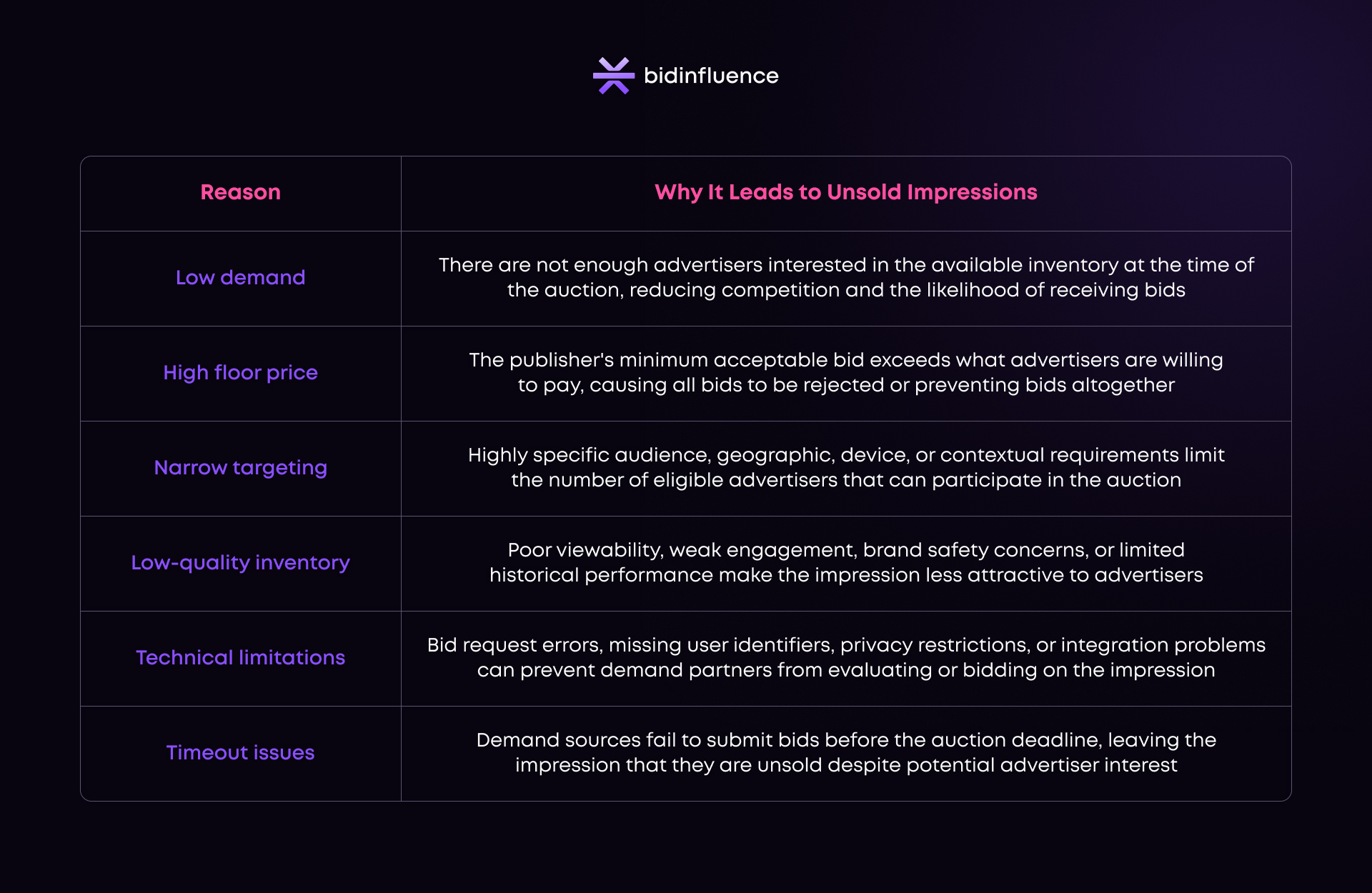
One of the most common reasons an ad impression goes unsold is low demand. At certain times of the day, during seasonal fluctuations, or within niche audience segments, there may simply not be enough advertisers competing for available ad inventory. Even in large programmatic marketplaces, demand is rarely consistent across every ad impression.
Another important factor is the publisher’s floor price. If the minimum acceptable bid is set higher than what advertisers are willing to pay, the RTB auction may end without a winning bid. Narrow targeting can create a similar outcome. Ad inventory aimed at highly specific audiences, devices, locations, or user characteristics may attract fewer eligible buyers.
Inventory quality also plays a significant role. Advertisers may avoid impressions from websites with low engagement, poor viewability, brand safety concerns, or limited historical performance. As a result, these ad impressions receive fewer bids or none at all.
Technical issues can also prevent successful auctions. Slow page load times, bid request errors, missing user identifiers, privacy restrictions, or timeout limits may prevent demand partners from responding before the RTB auction closes. In these cases, the ad impression remains unsold even though advertisers may have been interested under normal conditions.
What Happens After an Impression Receives No Bid?
When an RTB auction ends without a winning bid, the impression does not automatically go unused. Instead, the publisher’s ad server follows a predefined sequence of actions based on its monetization strategy. The goal is to maximize fill rate while maintaining acceptable revenue and user experience.
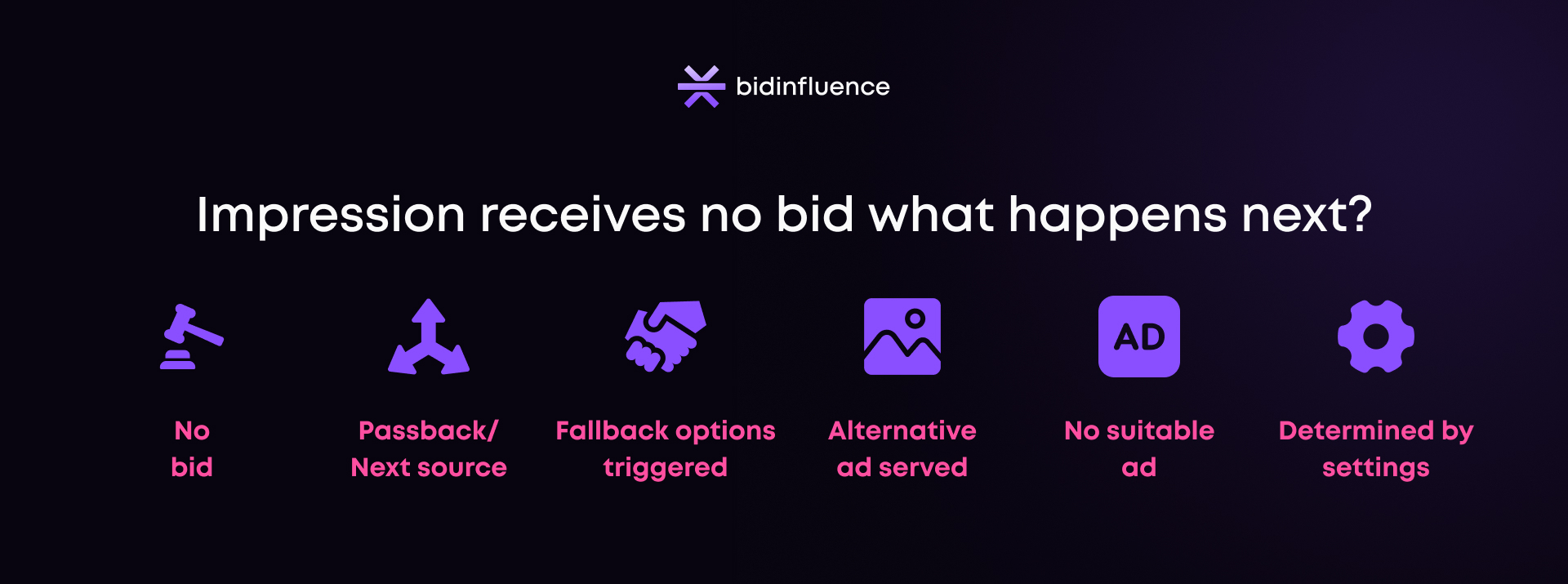
One common outcome is a passback, where the publisher forwards the impression to another demand source or ad exchange for another opportunity to find a buyer. In waterfall or hybrid programmatic monetization setups, the impression may move to the next auction or to a different demand partner with different pricing conditions. If a direct campaign serves as a fallback, the ad server instead delivers the advertiser’s guaranteed creative.
Publishers may also choose to display a house ad that promotes their own products, services, newsletters, or other internal content. Alternatively, the system can send the impression to a fallback ad network that specializes in filling unsold ad impressions that premium buyers decline.
If none of these options results in a suitable ad, the placement may remain empty. The publisher’s monetization settings, demand sources, pricing rules, and fallback priorities determine the exact outcome and how the system handles unsold ad impressions and ad inventory.
How SSPs Help Reduce Unsold Inventory
Supply-side platforms (SSPs) help publishers maximize the value of their ad inventory while reducing unsold ad impressions. Instead of relying on a single source of demand, an SSP connects publishers with multiple ad exchanges, DSPs, and advertising networks. This increases competition for each impression and improves the chances of finding a suitable buyer.
SSPs also use floor price optimization to balance fill rate and revenue. Rather than applying a fixed minimum price to every impression, many SSPs adjust floor prices dynamically based on demand, audience characteristics, and historical RTB auction performance. This helps avoid situations where inventory remains unsold because the minimum bid is set too high.
Many SSPs support header bidding, allowing several demand partners to compete simultaneously before the ad server selects a winner. In addition, AI-driven optimization can analyze programmatic auction data, predict bidding behavior, and recommend better pricing or routing decisions.
Traffic quality analysis helps identify invalid traffic and improve inventory attractiveness for advertisers, while dynamic auction management automatically chooses the most effective auction path for each impression. Together, these tools increase competition and reduce the likelihood of unsold ad impressions.
Why Unsold Impressions Matter for Publishers
A high number of unsold ad impressions directly reduces a publisher’s ability to generate advertising revenue. Every impression that goes unfilled represents a missed monetization opportunity. Over time, a low fill rate can reduce total earnings, lower effective CPM (eCPM), and make overall ad inventory performance less predictable. Consistently high volumes of unsold ad inventory may also indicate pricing, demand, or SSP configuration issues that require attention.
Publishers can reduce the percentage of unsold impressions by applying several proven optimization strategies:
- Improve ad inventory quality
Increase viewability, strengthen content quality, and maintain a brand-safe environment to attract more advertisers.
- Optimize floor prices
Set realistic minimum bid thresholds that balance revenue goals with a healthy fill rate.
- Increase demand sources
Connect to additional SSPs, ad exchanges, and demand partners to create more bidding opportunities for every ad impression.
- Implement header bidding
Allow multiple buyers to compete simultaneously, increasing RTB auction competition and improving fill rate.
- Improve page speed and viewability
Faster-loading pages and highly viewable ad inventory encourage greater advertiser participation.
- Monitor auction analytics
Regularly review RTB auction performance, bid responses, fill rate, and ad inventory metrics to identify inefficiencies and improve programmatic monetization.
Together, these practices help publishers improve monetization efficiency, increase competition for ad inventory, boost fill rate, and reduce unsold ad impressions.
Why Zero Unsold Ad Impressions Isn’t Always the Goal
Although reducing unsold ad impressions is an important objective, eliminating them is neither realistic nor always beneficial. Every publisher must balance the desire for a high fill rate with the need to protect the value of their ad inventory. Accepting every available bid simply to fill all ad placements can result in lower CPMs and reduced overall revenue.
Programmatic monetization is most effective when publishers focus on the quality of demand rather than volume alone. Maintaining appropriate floor prices, attracting competitive buyers, and prioritizing high-value ad inventory often means that some ad impressions will remain unsold. In many cases, this is a better outcome than selling inventory at prices that do not reflect its true value.
The ultimate goal is not to achieve a 100% fill rate. Instead, publishers should aim for the optimal balance between fill rate, CPM, demand quality, and programmatic efficiency. This approach supports stronger long-term monetization, more stable revenue, and a healthier programmatic advertising strategy.