
Why Bid Request Quality Matters in Programmatic?
In every real-time bidding (RTB) auction, the process begins with a bid request. This is the request that a supply-side platform sends to demand-side platforms through an ad exchange, describing the available ad impression and the context in which it will be served. Within milliseconds, advertisers evaluate this information to decide whether the impression matches their targeting goals and how much they are willing to bid.
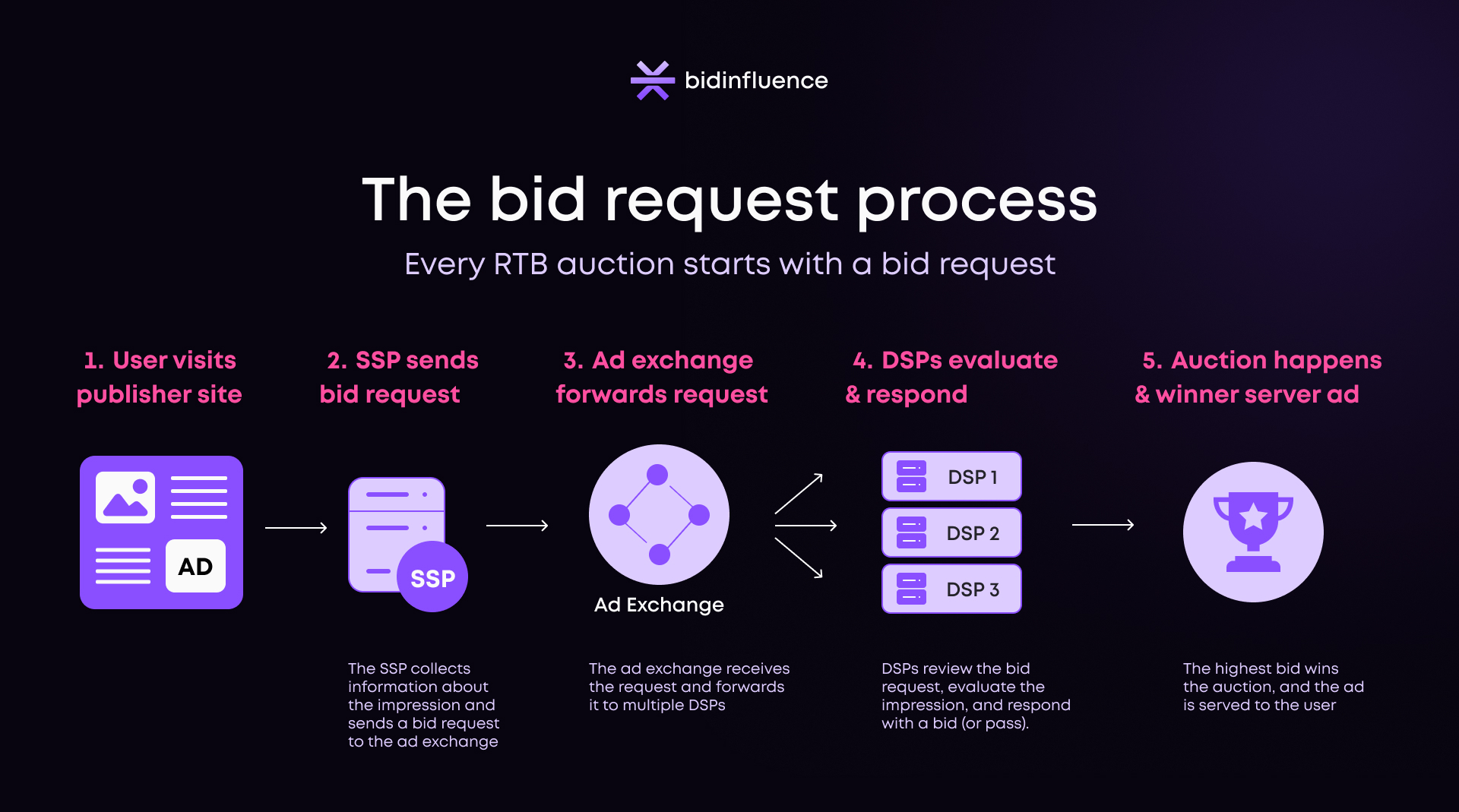
The quality of a bid request has a direct impact on auction performance. A request that contains accurate, complete, and well-structured data gives buyers greater confidence in the available inventory. It allows them to make more informed bidding decisions, apply advanced targeting strategies, and assign a fair market value to each impression.
On the other hand, incomplete or inconsistent bid requests can reduce buyer interest, limit competition, and lower bid prices. As a result, publishers may see fewer bids, reduced fill rates, and lower revenue. Ensuring high-quality bid requests is therefore a fundamental part of maximizing the value of programmatic inventory.
What Is a Bid Request?
A bid request is a standardized data package that describes an available ad impression in a real-time bidding auction. The SSP creates it and sends it through an ad exchange to multiple demand-side platforms. The request gives advertisers the information they need to evaluate the impression and decide whether to submit a bid.
You can think of a bid request as the passport for every impression. Just as a passport provides essential information about a traveler, a bid request provides the key details about the advertising opportunity. The more complete, accurate, and trustworthy the information is, the easier it is for buyers to determine whether the impression matches their campaign goals.
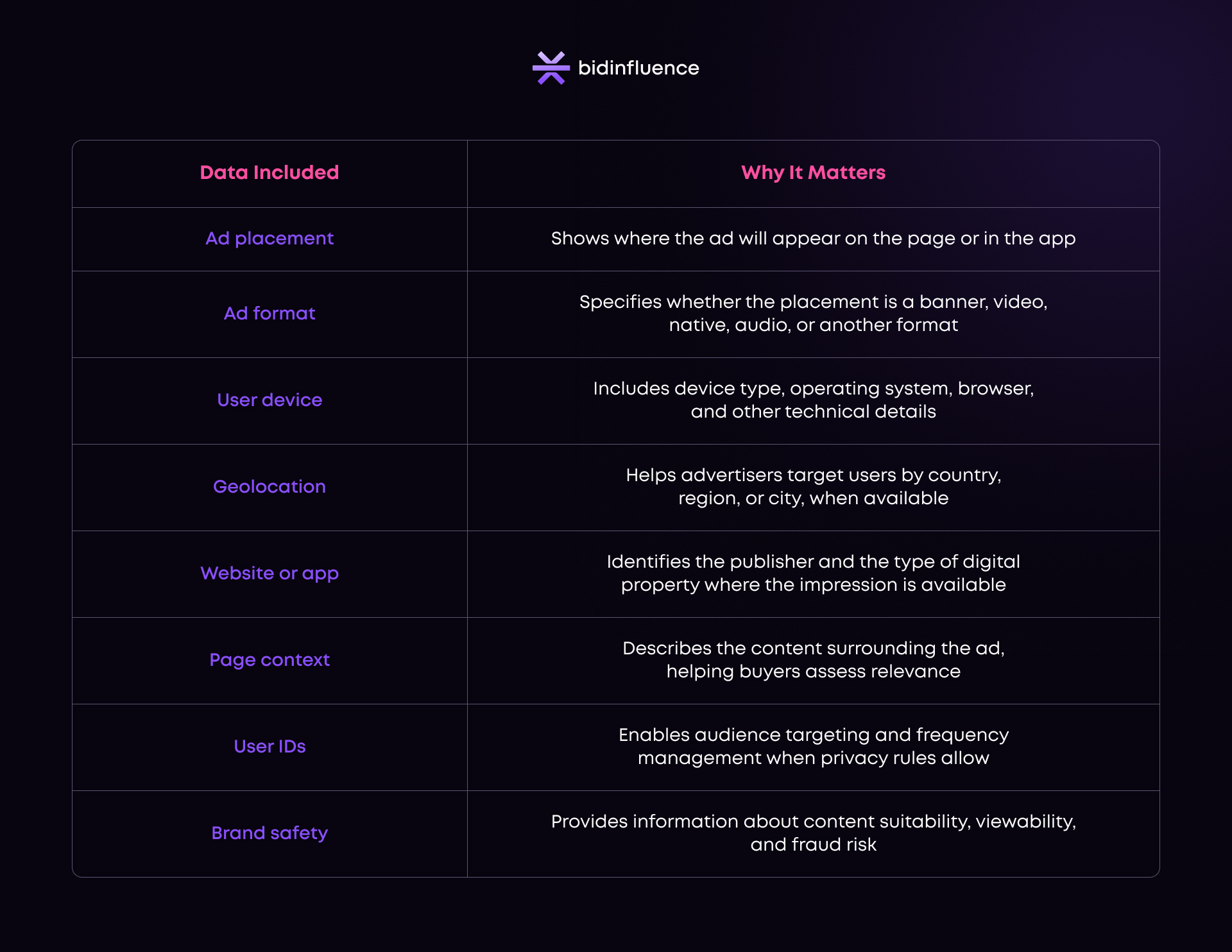
Based on this information, the DSP decides whether the impression is relevant for its advertisers, estimates its value, and determines how much to bid. A detailed, accurate bid request increases buyer confidence and creates stronger competition for the impression, while missing or unreliable data can reduce demand and lower auction performance.
How DSPs Evaluate Bid Requests
Once a demand-side platform receives a bid request, it has only a few milliseconds to decide whether the impression is worth bidding on. During this short window, the DSP analyzes multiple signals to estimate the impression’s value, determine its relevance to active campaigns, and calculate an appropriate bid price.
Key evaluation factors include:
Campaign targeting alignment
The DSP checks whether the impression matches the advertiser’s targeting criteria, such as location, device, audience, content category, or time of day. A close match increases the likelihood of a bid.
Inventory quality
The platform evaluates the publisher’s reputation, placement quality, and the overall reliability of the available inventory. Higher-quality inventory typically attracts stronger demand.
Probability of conversion
Machine learning models estimate the likelihood that the user will complete the desired action, such as clicking, registering, or making a purchase. Higher predicted performance supports higher bid values.
Brand safety
The DSP verifies that the content surrounding the ad is suitable for the advertiser’s brand and complies with campaign requirements.
Viewability
The platform estimates whether the ad is likely to be seen by the user. Impressions with higher expected viewability are generally more valuable.
Availability of user identifiers
Privacy-compliant user IDs or other identifiers help advertisers improve audience targeting, frequency management, and campaign measurement.
Completeness of transmitted signals
The DSP evaluates whether the bid request contains sufficient technical, contextual, and audience data. Rich, accurate signals reduce uncertainty and enable more confident bidding decisions.
The more complete and reliable the bid request is, the more accurately a DSP can assess the value of an impression. Better information leads to stronger buyer confidence, more competitive bidding, and a greater chance of maximizing revenue for the publisher.
Why Bid Request Quality Directly Impacts Revenue
The quality of a bid request directly influences how much revenue a publisher can generate from each impression. Since DSPs make bidding decisions based on available information, richer and more accurate data helps buyers evaluate inventory with greater confidence and assign higher value.
Several factors explain this relationship:
- More signals lead to more competition. Detailed technical, contextual, and audience data makes inventory relevant to more advertisers, increasing DSP participation in auctions.
- Higher competition increases CPM. More buyers competing for an impression drives up the clearing price and publisher revenue.
- Less uncertainty improves bid rates. Complete data helps DSPs estimate impression value more accurately, increasing the likelihood of bids.
- High-quality metadata improves campaign matching. Accurate placement, content, device, and audience information helps DSPs identify impressions that align with advertiser goals, often resulting in higher bids.
Every additional high-quality signal helps buyers make better decisions. Better data attracts more bidders, increases auction pressure, and enables publishers to maximize programmatic revenue.
How SSPs Improve Bid Request Quality
SSPs go beyond simply forwarding bid requests to DSPs by processing and improving each request before it reaches the RTB auction. This ensures buyers have access to accurate, complete, and trustworthy impression data. Better data helps advertisers evaluate inventory and determine its value.
Modern SSPs enhance bid requests through processes such as adding signals, validating data accuracy, refining metadata, and providing brand safety details. These improvements help advertisers assess inventory quality and suitability before bidding. They also remove invalid or incomplete requests that could reduce buyer confidence or cause missed opportunities.
Many SSPs use artificial intelligence and machine learning to improve signal quality. These technologies detect missing information, improve data consistency, and provide richer insights for more accurate bidding decisions.
An SSP is therefore much more than a technical intermediary. By improving the completeness, accuracy, and relevance of bid requests, it makes impressions more attractive to buyers, increases auction competition, and helps publishers achieve higher CPMs and stronger programmatic revenue.
Why Better Bid Requests Create Better Auctions
Every RTB auction begins with a bid request, making it the foundation of the programmatic buying process. Even valuable impressions can be undervalued if DSPs receive incomplete or inaccurate information and cannot properly assess their potential.
High-quality bid requests reduce uncertainty by providing the technical, contextual, and audience signals buyers need to make confident bidding decisions. As a result, more DSPs participate in the auction, increasing competition for each impression.
Greater competition leads to higher CPMs and more effective monetization for publishers. At the same time, advertisers benefit from better targeting and greater transparency because they can identify inventory that matches their campaign objectives.
Ultimately, better bid requests create better auctions. Complete and reliable data helps maximize the value of every impression while improving outcomes for both publishers and advertisers.